Home / Inspiration / Gallery walls
How to mix and match prints
How to put different prints on one wall and make them look like they belong together.
The best gallery walls rarely use prints from one series. They mix subjects, styles and sizes, and still look like a set. The secret is choosing what stays the same and what is allowed to change.
How do you mix and match prints on one wall?
Keep one thing the same and let everything else change. The easiest constant is colour: if every print shares one colour family, you can mix subjects, styles and sizes freely. Other good constants are frame finish, mood or even spacing. Then lay the prints out on the floor, swap any that jump out, and hang the largest piece first.
Keep the same
One colour family, one frame finish or one mood
Free to change
Subject, style and size
Anchor
One larger print, usually off-centre
Gaps
Even, about 5 to 8 cm
Test
Lay it out on the floor or try it on a photo
1. Keep one colour constant
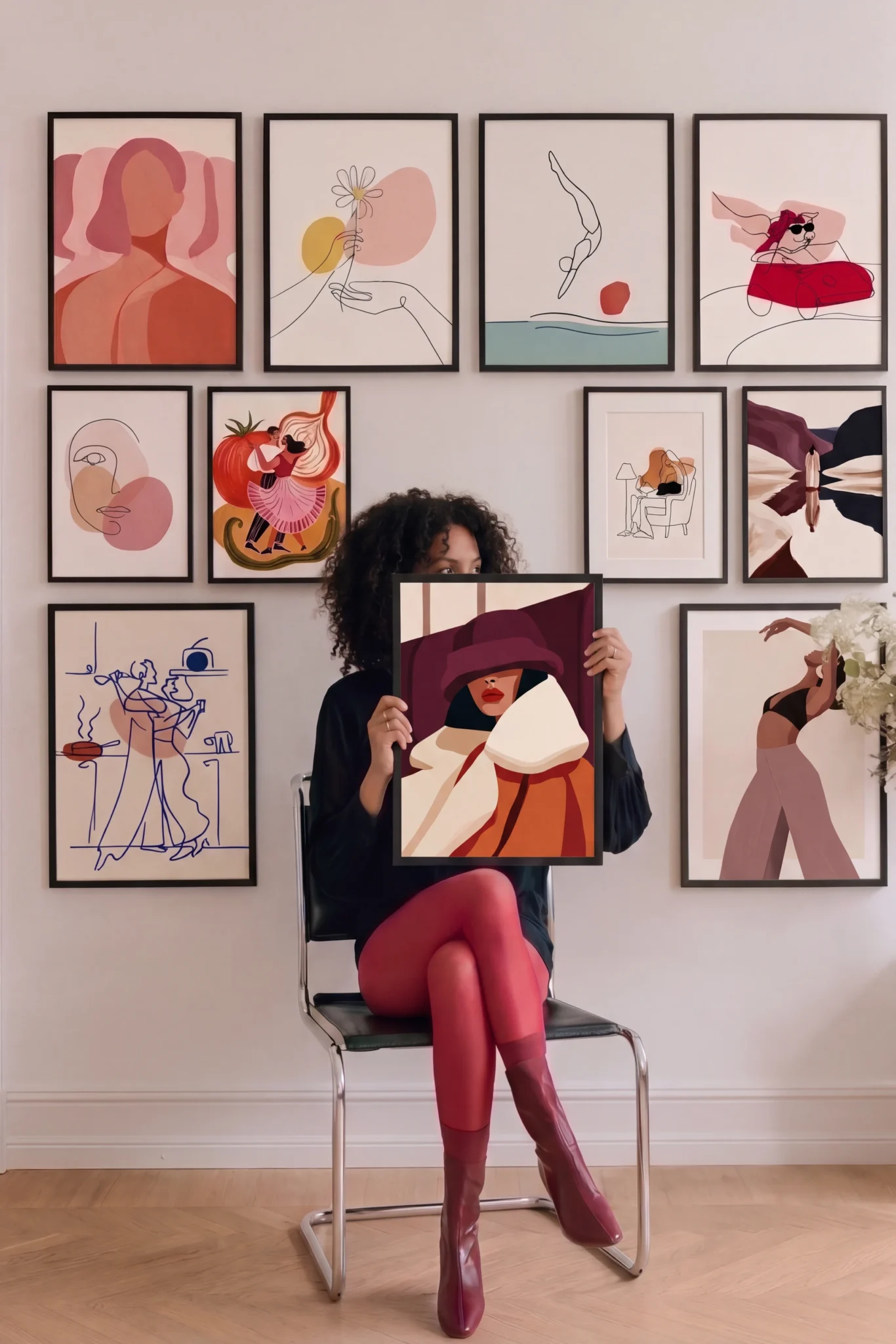
The Line and Colour Salon, shown at the top of this page, mixes twelve different prints: faces, florals, shapes and type. Every one of them sits in the same pinks and reds, so a busy salon wall still reads as one piece.
The Line and Colour Salon: twelve subjects, one colour family.
2. Mix subjects, match the mood
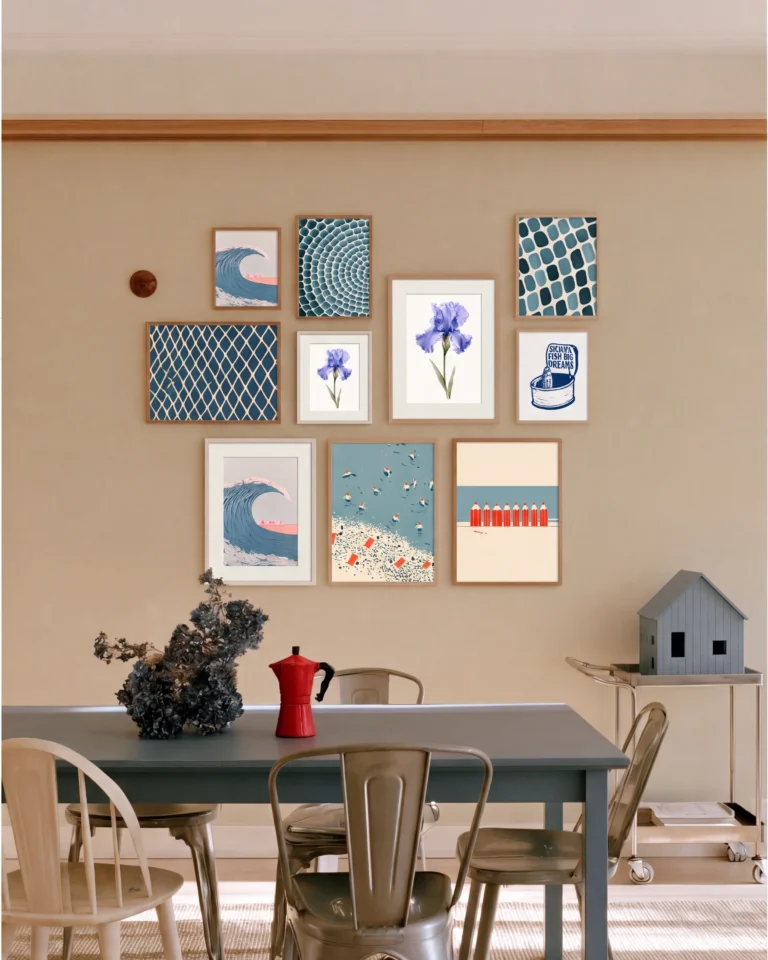
The Snail and Fruit Trio puts three quite different subjects side by side above a sofa. They work because all three are playful, flat and bright. Choose prints that share a feeling, even if the subjects have nothing in common.

The Snail and Fruit Trio: different subjects, one playful mood.
Studio tip
Pick one rule and keep it: the same colour, the same frame finish or the same style. Change everything else freely.
3. Mix graphic and painterly
The Doorway and Koi Trio pairs two crisp graphic prints with one painted still life. The contrast between hard and soft edges makes the wall more interesting than three matching prints would be.

The Doorway and Koi Trio: two graphic prints and one painted piece.
4. Mix sizes with one anchor
A mixed wall looks planned when one print is clearly the biggest. Start with that anchor, a print around 50 cm or more on its longest side, and build smaller pieces around it. Keep the outer edges of the group roughly straight, so the shape of the whole wall is tidy even if the inside is varied. Mixing portrait and landscape prints adds rhythm; just keep the gaps between them even, about 5 to 8 cm. For help with sizes, see how to choose the right wall art size.
5. Matching or mixed frames?
If your prints are very different, matching frames hold them together: all black, all oak or all white. If your prints are already close in colour and style, mixed frames add warmth and a collected feel. A good middle ground is two finishes, such as black and natural oak, with each one used at least twice so neither looks like an accident. Read more in how to frame wall art.
6. Start small: pairs and trios
You do not need twelve prints to practise mixing. A pair or a trio is the easiest place to start. Choose two or three prints that share one colour, then make one of them a different style, such as a line drawing next to a painted piece. Hang them in a row above a sofa or sideboard, keeping the centre of the group about 145 cm from the floor. Once that feels right, add more around it. Our gallery wall sets are already mixed for you if you would rather not choose.
How to test a mix
Lay the prints on the floor before you hang anything and look at them from across the room. If one jumps out, swap it. Or try the combination on a photo of your own wall first.
Common mistakes when mixing prints
The most common is changing everything at once: different colours, frames, styles and sizes with nothing to tie them together. Another is choosing prints that are all the same size, which makes a mixed wall look flat. Uneven gaps are a third, because they make a varied wall look messy rather than collected. And hanging before testing: a quick layout on the floor saves holes in the wall.
Next, read gallery wall layout ideas or how to hang a gallery wall.
Mixing prints questions
Can I mix photographs and illustrations?
Yes. Keep the colours close, for example black and white photos with black line drawings, and use the same frame finish for both.
How many different prints can I mix?
There is no fixed limit. A salon wall can mix twelve or more, as long as one thing, usually colour, stays the same across all of them.
Should frames match on a mixed wall?
Matching frames help very different prints feel like a set. If the prints already share a colour, two frame finishes work well too.
Where should I start a mixed gallery wall?
Start with the largest print, slightly off-centre, and build outwards. See how to create a gallery wall for a step-by-step plan.
Shop the walls in this story

Set of 12
The Line and Colour Salon

Set of 3
The Snail and Fruit Trio

Set of 3